
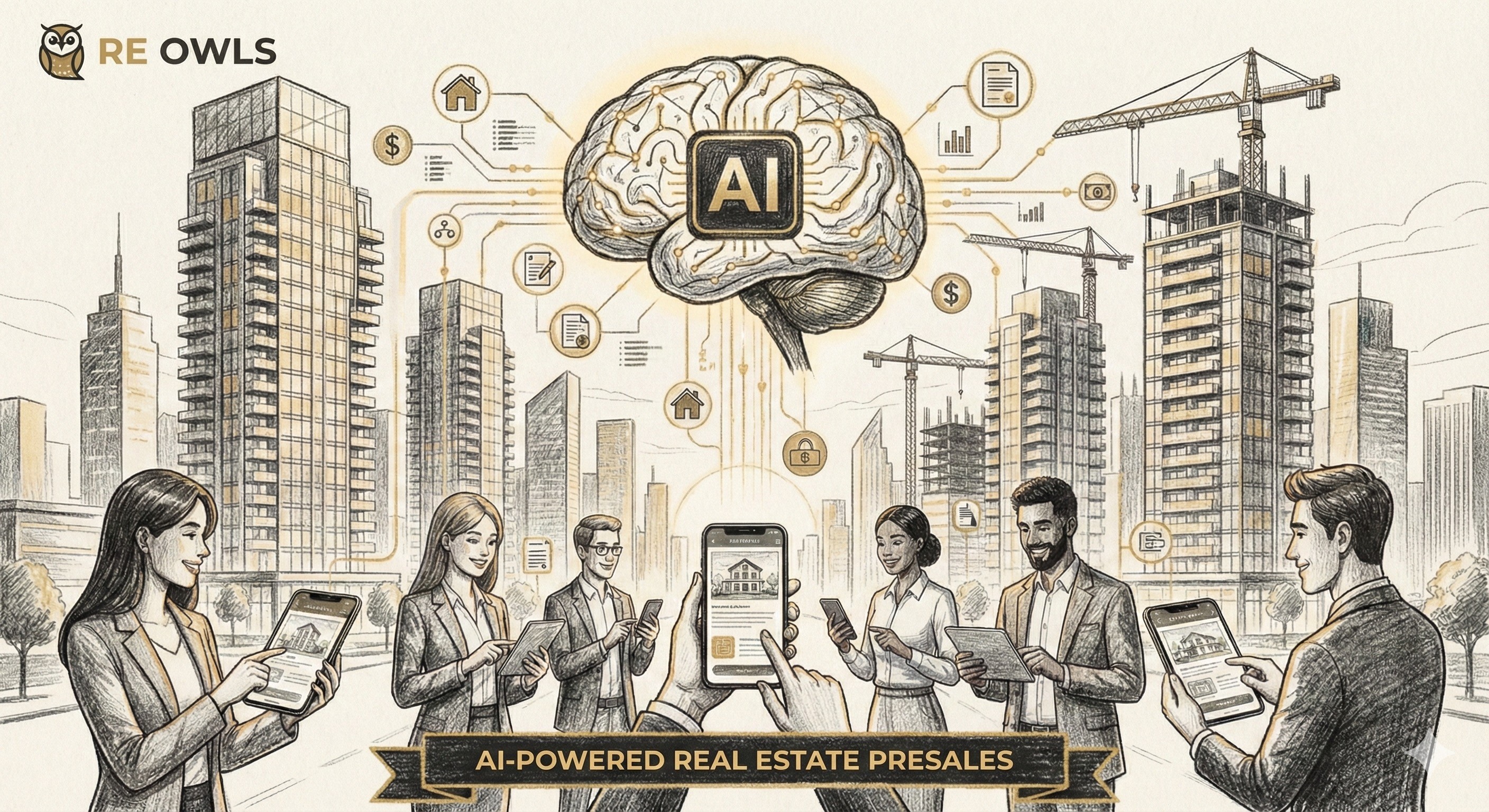
Why AI in real estate presales Is Now a Revenue Strategy (Not Just a Cost Play)

For years, AI in property and construction was pitched as a back-office efficiency thing: automate reports, clean data, maybe forecast demand. But the latest wave of AI is different. It’s landing right inside marketing & sales, where revenue is actually made.
McKinsey’s global AI research shows that marketing and sales is the #1 function where companies report real revenue lift from AI, more than any other area. That means when AI moves the needle, it usually does so through the funnel: who you reach, how you sell, and how many of those conversations turn into revenue.
For developers, brokers, and project marketers, this is exactly where AI in real estate presales can become a competitive weapon. Same project, same city, same market—but a smarter funnel that:
Attracts more of the right buyers
Prioritizes the deals most likely to close
Equips reps to sell better, faster
Protects bookings from cancellation
Builds more revenue per customer over time
That’s what this blueprint is about.
From Hype to EBIT: What Data Says About AI in Revenue
Pulling from McKinsey’s 2025 State of AI report, a few patterns stand out:
Companies using AI in marketing & sales are the most likely to report AI-driven revenue gains.
Only a small slice of “AI high performers” get >5% of EBIT from AI, and they’re far more likely to use AI in customer-facing functions.
These high performers explicitly set growth and innovation (not just cost-cutting) as a core AI objective and redesign workflows around AI instead of layering tools on top of old habits.
In other words: the value is real, but it’s concentrated in firms that treat AI as a growth engine.
Why Marketing & Sales in Real Estate Are the Ideal Beachhead for AI
Real estate presales are almost custom-designed for AI leverage:
High-ticket decisions with long, information-heavy journeys
Tons of behavioral signals: website visits, call logs, WhatsApp threads, CRM notes, portal inquiries
Clear funnel stages (awareness → interest → visit → booking → registration)
Measurable revenue outcomes: bookings, upgrades, referrals
All of that makes AI in real estate presales a natural fit. The key is to build intentionally, stage by stage.
Step 1: Map Your Presale Funnel End-to-End Before Adding AI
Before any tools, models, or prompts, you need a simple but honest picture of your current funnel.
Awareness → Interest → Visit → Booking → Post-Sale: The Core Stages
Most presale funnels follow some version of:
Awareness – Ads, portals, signage, email, social
Interest – Landing pages, lead forms, brochures, early conversations
Visit – Site visits, show suites, virtual tours
Booking – Token payments, paperwork, agreements
Post-Sale – Collection, upgrades, referrals, cancel risk
At each stage, ask:
What actually happens today?
Where do we lose the most people?
Where does a 10% lift make the biggest revenue difference?
You’re not mapping tech yet—you’re mapping leaks in the bucket.
Defining Revenue KPIs at Each Funnel Stage
To keep AI honest, each stage needs a KPI tied to money:
Awareness → Cost per qualified lead (CPL-QL)
Interest → Lead-to-visit rate
Visit → Visit-to-booking conversion
Booking → Cancellation rate, average booking value
Post-Sale → Upsell revenue per customer, referrals per 100 buyers
From Impressions to Bookings: Translating Metrics to Money
Example:
10,000 impressions → 200 leads → 60 visits → 18 bookings
Every 1 extra booking in presales could be worth hundreds of thousands in revenue
Even a small AI-induced lift at multiple touchpoints compounds into meaningful top-line impact.
Step 2: Use AI to Supercharge Demand Generation & Audience Targeting
Now, plug AI into the top of the funnel to bring in more of the right buyers, not just more clicks.
AI-Powered Audience Discovery & Lookalike Buyers
Feed your past booking data into models (or platform lookalike tools) to identify patterns:
Area of residence and workplace
Budget range and financial profile
Engagement level with specific amenities or unit types
Investor vs. end-user behaviours
The model learns what your best buyers look like and finds people who resemble them.
Result: the same ad budget reaches higher-intent prospects, lifting your lead-to-visit conversion down the line.
Creative & Messaging Generation at Scale for Different Buyer Personas
Use generative AI to create messaging streams for:
Young professionals buying their first apartment
Growing families upgrading for more space
Investors seeking rental yield and capital appreciation
NRI buyers looking for trusted brands and hassle-free management
For each persona, AI can generate:
Ad copy variants
Email angles
Landing-page headlines & body copy
WhatsApp templates
Instead of one “best” ad, you run parallel angles optimized to different psychologies.
Budget & Channel Mix Optimization Driven by Predicted Revenue
Rather than optimizing only for CTR or leads, AI models can forecast:
Which channel combinations (Meta, Google, portals, broker networks) produce actual bookings
How changing spend mix by 10–20% affects expected revenue
The blueprint here:
Track channel source all the way to booking.
Use AI to learn which paths produce the highest revenue per dollar spent.
Reallocate media dynamically.
That’s how you turn AI from a “creative helper” into a media investment brain.
Step 3: AI-First Lead Capture, Scoring & Warm-Up Flows
Once demand hits your forms and inboxes, AI takes over to qualify and warm leads.
Smart Lead Forms & Chatbots That Qualify in Real Time
Replace static forms with conversational capture:
“What budget are you considering?”
“Are you planning to live here or invest?”
“How soon are you planning to buy?”
AI can respond instantly with relevant project information while quietly building an intent profile.
Lead Scoring Models That Tell You Who to Call First
Feed the model:
Source (portal, organic, referral, ad set)
Pages viewed, time spent, return visits
Interaction with pricing/availability content
Responses to chatbot questions
Get back a score (0–100) indicating probability to:
Book a visit
Book a unit
Your team gets a daily “who to call first” list and a view of which leads need more nurture before sales steps in.
Nurture Journeys Based on Intent, Not Just Time Delays
Instead of a generic 5-email drip, AI creates:
Journeys for actively comparing projects
Journeys for early-stage researchers
Journeys for ready-now buyers
Triggers might include:
Downloading a brochure but not booking a visit
Checking pricing 3 times in a week
Opening but not replying to emails
AI adjusts content and timing automatically, nudging each lead toward a visit with the right message at the right moment.
Step 4: AI-Augmented Site Visits & Sales Execution
The visit is the make-or-break moment. Here, AI lifts both close rate and average booking value.
Sales Copilots: Briefings, Objection Handling & Next-Best-Action
Before a visit, an AI copilot can generate a one-page brief for the rep:
Buyer’s online behavior
Stated budget & timeline
Most-viewed unit types
Likely objections based on similar profiles
During or after the conversation, the copilot suggests:
What to highlight next (amenity, view, scarcity, payment plan)
How to frame responses to common objections
What follow-up asset to send (video, FAQ, plan comparison)
This raises the average skill level of every rep, not just the top 10%.
Using AI to Personalize the Onsite or Virtual Tour
AI can:
Recommend which units to show first based on buyer profile
Highlight ROI or lifestyle angles accordingly
Generate custom “tour recaps” with visuals and key data after the visit
The buyer feels seen and understood—not treated as Lead #247.
Optimizing Follow-Ups After Each Visit with GenAI
After each visit, AI:
Summarizes the conversation into the CRM
Drafts a tailored follow-up email or message
Suggests the next touch: price breakdown, payment option, comparison table, or testimonial relevant to that persona
That consistent, personalized follow-up is what turns strong interest into actual bookings.
Step 5: Streamlining Booking & Documentation with AI
Removing friction at booking time can be the difference between “we’ll think about it” and “let’s go ahead.”
Payment Simulation, Affordability & EMI Coaching
AI-driven calculators and assistants can:
Show payment plans side by side
Break down EMIs into clear monthly commitments
Simulate scenarios (higher down payment vs. longer tenure)
This reduces anxiety and helps buyers self-justify the purchase.
Document Automation & Error Reduction
AI can auto-populate:
Allotment letters
Agreements
Payment schedules
Summary sheets for internal use
It can also flag inconsistencies or missing fields before anything goes to the buyer.
Result: fewer back-and-forth loops, faster booking completion, and a smoother buyer experience.
Negotiation Guardrails: Protecting Price While Closing Faster
AI models can provide reps with:
Discount bands allowed per unit type
Rules for what to offer at which stage (e.g., floor rise waiver, furniture credit)
Alerts when a proposed offer is out of policy
Reps don’t need to stall to “check with my manager” on every detail. Buyers get faster answers, and pricing integrity is maintained.
Step 6: AI for Retention, Cancellations Risk & Post-Sale Expansion
Revenue isn’t secure until registrations are done and cancellations stay low.
Churn Prediction & Rescue Journeys for At-Risk Bookings
AI can monitor:
Delays in signing documents
Repeated questions about refunds or cancellation terms
Payment irregularities
Drop in engagement with project updates
This surfaces a “risk of cancellation” score.
You can then trigger:
Personalized reassurance calls
Alternate payment plan offers
Priority support to resolve concerns
Even a small reduction in cancellation rate makes a big dent in realized revenue.
Upsell/Cross-Sell: Parking, Upgrades & Adjacent Investments
AI recommends relevant add-ons:
Extra parking
Storage units
Premium views or larger configurations
Furniture or interior packages
Nearby projects or plots for investors
These offers are based on buyer profile, budget, and past response patterns.
Referral Engines Powered by AI Signals
Identify happy customers by:
Positive NPS or feedback
Engagement with community events
On-time payments
Then prompt them with:
Structured referral programs
Easy referral journeys (shareable links, pre-filled forms)
Timely nudges when excitement is high (handover, possession, milestones)
AI tracks this end to end, turning satisfaction into low-CAC new demand.
Step 7: Operating Model of an “AI High Performer” in Presales
To behave like McKinsey’s “AI high performers,” you need more than tools.
Setting Explicit Growth KPIs for AI in real estate presales
Examples:
+15% lead-to-visit rate in 6 months
+10–20% visit-to-booking conversion
–25% cancellation rate
+15% upsell revenue per buyer
Every AI effort is evaluated against these, not just “emails sent” or “tickets closed.”
Redesigning Workflows, Not Just Adding Tools
Instead of “old process + AI garnish,” you rebuild:
How leads are routed
How reps prepare for calls
How marketing messages are chosen and sequenced
How management reviews performance (revenue-centric dashboards)
You’re changing who does what, when, and with what support.
Scaling AI Agents Across Marketing & Sales
Over time, you introduce specialized AI agents:
Media Mix Agent – suggests weekly budget shifts across channels
Lead Triage Agent – cleans, scores, and routes new leads
Sales Copilot – supports reps with briefs, scripts, and follow-ups
Retention Agent – monitors risk and triggers rescue journeys
These don’t replace humans—they amplify them.
Implementation Roadmap: 90-Day Plan to Launch Your AI Presale Funnel
Phase 1 (Days 1–30): Data, Tools, & Quick-Win Experiments
Connect website, CRM, and ad platforms
Implement basic lead scoring (rules + simple model)
Launch AI-powered chat on key pages (pricing, floorplans, contact)
Test GenAI-assisted follow-up emails for hot leads
Goal: prove lift in response rate and visit bookings.
Phase 2 (Days 31–60): Scaling AI Journeys Across the Funnel
Deploy persona-based messaging in ads and emails
Expand AI chat coverage and knowledge base
Use AI to generate sales briefs for all visits
Introduce basic payment simulation tools
Goal: improve conversion from lead → visit → booking.
Phase 3 (Days 61–90): Measuring Incremental Revenue & Doubling Down
Compare AI-enhanced campaigns vs. control
Analyze uplift in bookings and revenue per buyer
Identify your highest ROI AI interventions
Build an ongoing experimentation and optimization cadence
Goal: treat AI not as a one-off project but as a permanent revenue engine.
FAQs About AI in real estate presales
1. Is AI in real estate presales only for big developers with huge budgets?
No. You can start small with AI chatbots, AI-assisted copy, and simple lead scoring. Many tools are SaaS-based and priced per seat or per lead, so you can scale as you see ROI.
2. Will AI replace my sales team?
AI doesn’t replace the human moment of trust in high-ticket real estate. It handles the who, when, and what—who to contact, when to reach out, what to say—so your humans can focus on how to close the conversation in the room or on the call.
3. How fast can we see revenue impact?
You can often see measurable improvements in lead-to-visit and response rates within weeks of deploying AI for targeting and follow-ups. Larger structural gains in booking rates and churn usually appear over a few months.
4. What data do we need to start?
At minimum: lead source, basic lead profile, activity on your website or campaigns, and booking outcomes. Over time, add richer behavioral and transactional data for more powerful models.
5. Is this only for new launches, or can we use AI for ongoing inventory as well?
Both. AI can optimize launch campaigns and help move remaining inventory through hyper-targeted messaging and upsell/cross-sell strategies.
6. How do we avoid AI “hallucinations” in buyer-facing interactions?
Use guardrails: controlled knowledge bases, pre-approved answer templates, and strict fallback rules (e.g., “If not sure, hand over to human”). Start with narrow use cases and expand as you gain confidence.
Conclusion: Treat AI as the Revenue Engine of Your Next Launch
AI is already proving itself as a growth driver in marketing and sales across industries. When you deliberately design AI in real estate presales around your funnel—demand gen, lead scoring, sales execution, booking, and post-sale—you stop treating AI as a toy and start using it like a revenue machine.
The developers and brokers who win the next cycle won’t just have better projects. They’ll have better funnels, powered by AI at every stage.